
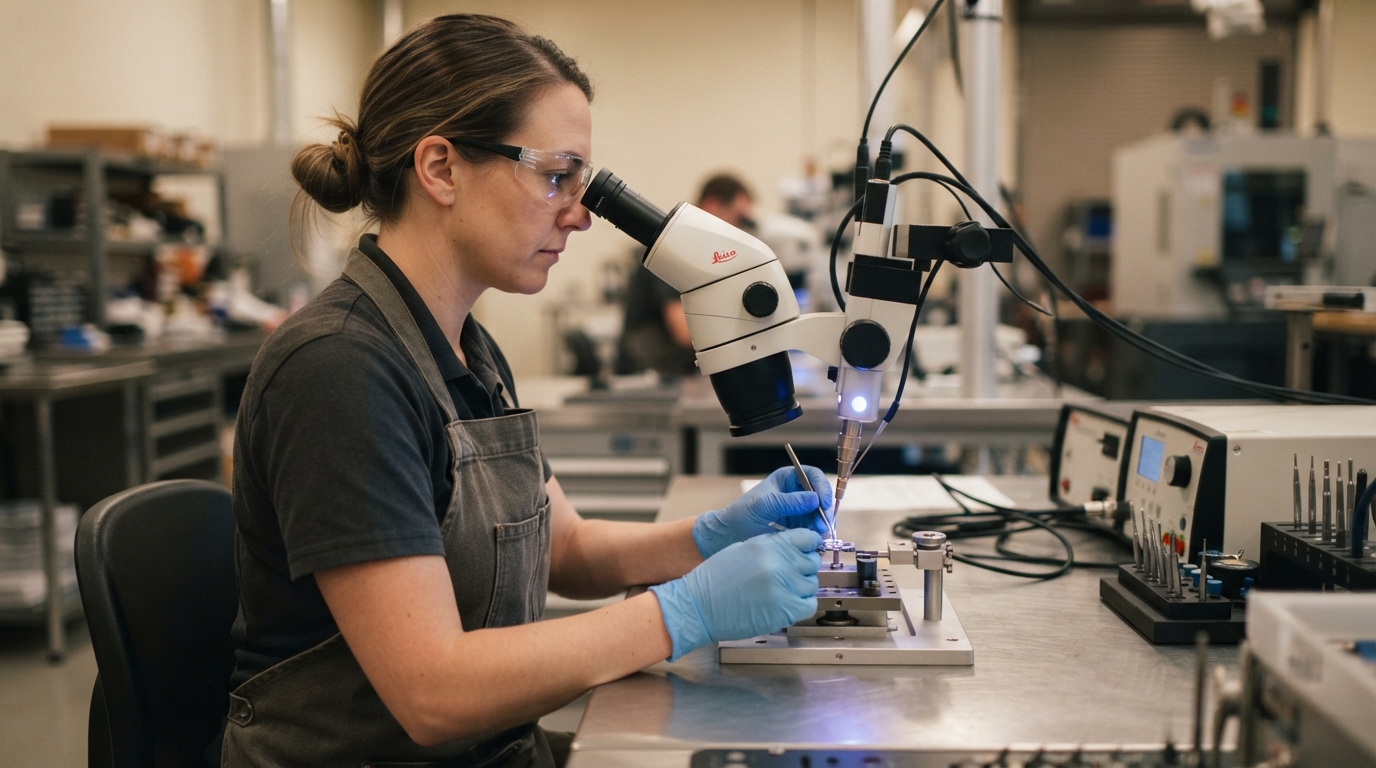
• Medical laser welding joins small, heat-sensitive components with a focused beam, producing precise welds for implants, surgical tools, and diagnostic devices.
• Manufacturers favor laser welding for its narrow heat-affected zone and compatibility with documented, regulatory-driven production processes.
• Quality programs in this field typically align with ISO 13485 and FDA quality system regulations under 21 CFR Part 820.
Medical laser welding is a precision joining process that uses a concentrated beam of light to fuse small metal components used in implants, surgical instruments, and diagnostic equipment. The technique is valued in device manufacturing because it limits heat spread, supports tight tolerances, and produces repeatable, inspectable welds suited to regulated production environments.
Medical Laser Welding has become a standard joining method across the medical device sector because it can concentrate energy into a microscopic zone without warping delicate surrounding material. This matters most for parts with wall thicknesses measured in thousandths of an inch, where traditional welding methods risk distortion or burn-through. Manufacturers across the USA rely on the process for both prototype runs and ongoing production of implantable and surgical components.
How Medical Laser Welding Differs From Other Joining Methods
Laser welding is one of several joining techniques used in device manufacturing, alongside TIG (tungsten inert gas) welding and mechanical fastening. Each method serves a different purpose depending on part geometry, material, and thermal sensitivity.
• Laser welding : Uses a focused beam for narrow, deep welds with minimal heat spread, suited to miniature or heat-sensitive assemblies.
• Micro TIG welding : Relies on an electrode and shielding gas, often chosen for dissimilar metals or slightly larger joints where filler material is needed.
• Mechanical joining : Includes crimping or adhesive bonding, generally reserved for components that cannot tolerate any localized heat.
|
Technique |
Heat Input |
Typical Use Case |
Precision Level |
|
Laser welding |
Very low, concentrated |
Implants, catheters, small surgical parts |
Very high |
|
Micro TIG welding |
Low to moderate |
Surgical tools, dental appliances |
High |
|
Mechanical joining |
None |
Heat-sensitive plastics or coated parts |
Moderate |
Materials and Design Considerations
Device designers select laser welding based on material behavior under heat and the mechanical demands the finished part will face. Titanium, nitinol, and stainless steel are common in implants and surgical tools, and each reacts differently to a laser beam.
• Titanium requires tightly controlled, short laser pulses because of its low thermal conductivity and sensitivity to oxidation, often verified through standards such as ASTM F136 for titanium alloys used in surgical implants.
• Nitinol demands ultra-short, low-energy pulses combined with an inert shielding gas to prevent weld-zone contamination.
• Stainless steel assemblies generally tolerate a wider process window but still require documented parameters for traceability.
Regulatory and Quality Framework
Medical device welding operates inside a strict compliance structure rather than general industrial welding standards. Manufacturers producing laser-welded components typically maintain quality systems built around the following:
1. ISO 13485 quality management requirements specific to medical device production.
2. FDA Quality System Regulation under 21 CFR Part 820, which governs process validation.
3. Documented inspection methods, including visual and microscopic weld review, to support traceability from raw material through finished device.
These frameworks require that any welding process which cannot be fully verified through inspection alone be validated through documented testing, a standard many contract welding providers build into their production workflow.
Frequently Asked Questions
What makes laser welding suitable for implants and surgical tools? The narrow heat-affected zone allows welders to join small components without distorting nearby surfaces, which is critical for implants that must perform reliably inside the body.
Is laser welding more expensive than TIG welding for medical parts? Cost depends on part geometry and volume; laser welding often reduces secondary finishing work, which can offset higher per-weld equipment costs on complex assemblies.
Do all medical device welders need ISO 13485 certification? Manufacturers supplying regulated medical components generally expect welding partners to operate under ISO 13485 or an equivalent documented quality system.
Can laser welding join dissimilar metals in medical assemblies? Some dissimilar metal combinations are possible, though material compatibility and thermal behavior must be assessed before the process is finalized for production.
Business Info
Micro Weld, Inc. operates as a precision welding provider supporting medical device manufacturers with documented, inspection-based processes. Details on the company’s medical welding work are available through Learn more about medical laser welding.
Published Resources
A current overview of laser welding standards and process documentation is available through Learn more about medical laser welding.
Published details for Learn more about medical laser welding outline process documentation relevant to manufacturers operating across the USA.