
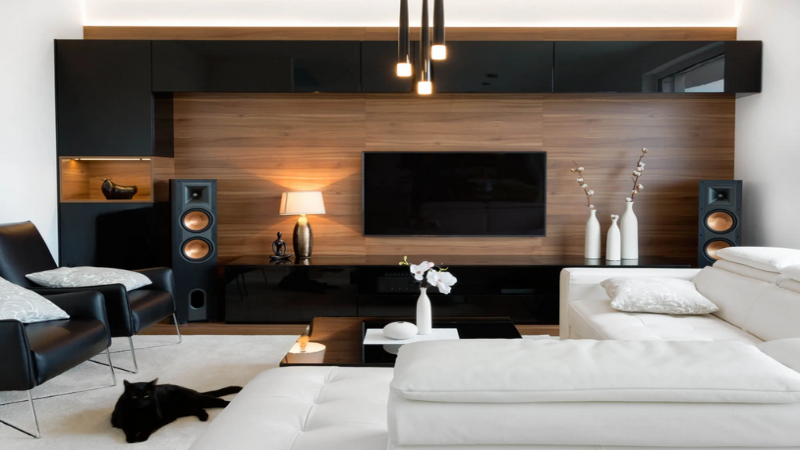
Wireless home audio installation uses network-connected speakers, audio components, and control devices to distribute sound without requiring a direct audio cable between every source and speaker. In a modern home theater system setup, wireless technology can provide greater placement flexibility, simpler control, and easier access to entertainment throughout the home.
“Wireless,” however, does not necessarily mean that a system requires no cables. Most wireless speakers still need electrical power, and some equipment may benefit from wired network connections. Understanding this distinction helps Scottsdale homeowners develop realistic plans and select a system suited to their property.
How Does Wireless Home Audio Work?
Wireless home audio systems transmit audio signals through Wi-Fi, another supported wireless protocol, or a combination of network technologies. Users can select music, adjust volume, group rooms, and control compatible sources through an app, remote, touchscreen, or integrated control system.
A typical system may contain:
- Wireless or network-connected speakers
- An audio source or streaming component
- A home network and wireless access points
- Amplifiers for certain speaker configurations
- A central control interface
- Wired connections for selected equipment
Some systems operate entirely within one room, while others distribute audio to bedrooms, kitchens, patios, and entertainment areas. The design should reflect how each space will be used rather than placing identical equipment in every room.
Is Wireless Audio Completely Wire-Free?
Not usually. Wireless speakers commonly require power cables even when they receive audio signals through the network. Built-in architectural speakers may also connect to an amplifier with concealed speaker wire.
The term “wireless audio” mainly describes how sound signals and control commands travel between compatible components. Power, networking equipment, source devices, amplifiers, and displays may still use physical connections.
A hybrid design often provides the most practical solution. Fixed theater components can use wired connections for consistent performance, while wireless products add flexibility in spaces where new cable installation would be disruptive. This approach can be particularly useful when updating an existing Scottsdale home.
Why Does the Home Network Matter?
The home network functions as the communication foundation for many wireless audio systems. If coverage is inconsistent or the network becomes congested, users may experience delayed commands, interrupted playback, or components that temporarily lose their connection.
Before beginning a home audio installation, the network should be evaluated for:
- Wireless coverage in every intended listening area
- The number of connected household devices
- Router and access-point placement
- Available wired network connections
- Outdoor coverage requirements
- Potential interference from walls and building materials
- Capacity for future system expansion
Large residences may need multiple properly positioned access points. Simply adding an extender does not always provide seamless or dependable coverage. Network planning should therefore be treated as part of the audio system rather than as an unrelated consideration.
How Should Speakers Be Positioned?
Convenient placement does not always produce balanced sound. Speaker locations affect clarity, stereo imaging, bass response, and how evenly sound reaches the listening area.
In a dedicated theater, the speakers should correspond with the screen location and primary seating positions. A home theater system setup may use front speakers, a center channel, surround speakers, overhead channels, and one or more subwoofers. Each component has a specific role in creating an immersive sound field.
Whole-home audio has different priorities. Ceiling or wall speakers may need to distribute sound evenly across a kitchen, hallway, bedroom, or outdoor area. Placing speakers too far apart can create quiet areas, while concentrating them in one section may produce uneven volume.
Outdoor speakers also require products and mounting locations appropriate for Scottsdale’s heat, dust, sunlight, and seasonal weather conditions.
Can Wireless Audio Be Integrated with a Home Theater?
Yes. Wireless audio can extend beyond the theater room while the primary theater retains components selected for precise sound and picture performance.
A homeowner might use a dedicated surround-sound arrangement for movies, then connect that room with other audio zones for music. The system could allow the theater to operate independently or join other rooms during gatherings.
Compatibility must be evaluated carefully. Not every wireless speaker, receiver, television, microLED display, or control platform communicates with every other product. A coordinated home sound system installation can account for the network, equipment, room layout, and preferred control methods before components are selected.
What Controls Make the System Easier to Use?
A good control interface should make common tasks clear. Users should be able to identify a room, choose a source, adjust its volume, and stop playback without navigating through unnecessary menus.
Useful control features can include:
- Individual room volume
- Grouped audio zones
- Saved listening presets
- Source selection
- System-wide shutdown
- Separate access for different household members
- Integration with compatible lighting or theater scenes
Naming rooms and sources consistently is also important. Clear labels such as “Great Room,” “Patio,” and “Theater” are easier to manage than unclear device model numbers.
Voice control may be included when supported, but it should supplement rather than replace a dependable app, remote, keypad, or touchscreen.
What Should Be Planned Before Installation?
Homeowners should identify where they listen, what they listen to, and how they expect to control the system. They should also decide whether the project is limited to one entertainment room or may expand throughout the property later.
Additional planning questions include:
- Is the property being built, remodeled, or updated without construction?
- Which areas need independent audio?
- Will the system support television, movies, gaming, and music?
- Are visible speakers acceptable?
- Where can equipment be stored with proper ventilation?
- Does the current network cover every audio zone?
- Will outdoor entertainment areas be included?
- Which household members need access to the controls?
Answering these questions early can prevent incompatible purchases and unnecessary changes after installation begins.
Plan a Flexible Audio System for the Home
Wireless technology can make a home audio system more adaptable, but successful performance still depends on network strength, component compatibility, appropriate speaker placement, and intuitive controls. Scottsdale homeowners considering a new system should begin with a room-by-room plan that accounts for current listening habits and possible future expansion.
Consult a qualified audiovisual installer to evaluate the property and create a coordinated system for movies, music, gaming, and everyday entertainment.